Wednesday, December 31, 2025

New Year, New Me. Sounds Nice. Rarely Works.

Rolling into a new year always seems to come with this strange cultural pressure to become a completely different person overnight. New year, new me. Flip the switch. Delete the old version. Install the upgrade. Then discover the upgrade has bugs and no rollback option. It sounds neat, but it almost never works that way in real life.
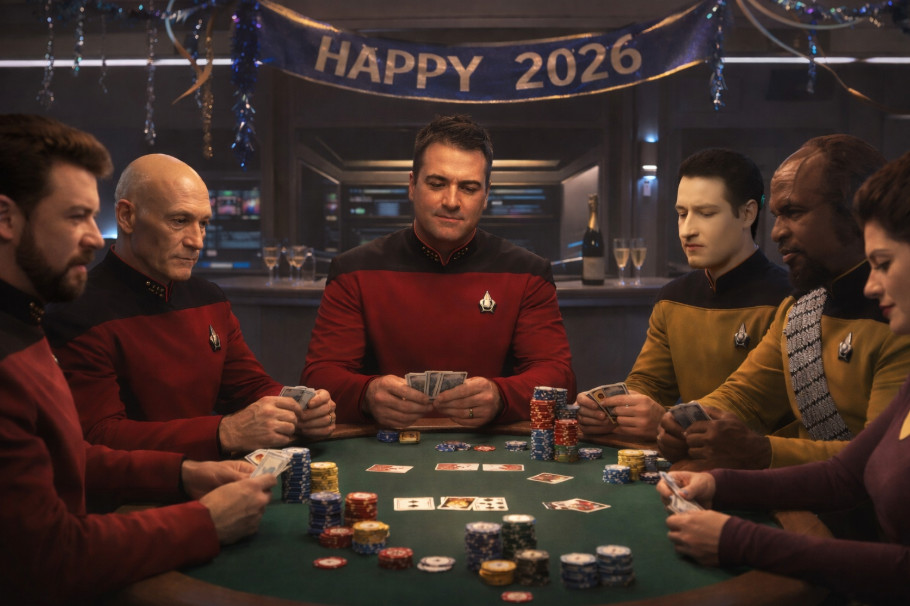
Star Trek themed poker night New Year image representing long term progress and patience

I wrote a few days ago about repetition and how real change comes from doing the same small things consistently, and I will link to that article again because it matters here. Big change usually fails not because people lack motivation, but because they aim for dramatic transformation instead of focused direction.

Every January I see the same thing. Someone decides they're done being a couch potato and declares they're now working out three hours a day, eating perfectly, sleeping eight hours, and never touching sugar again. That plan usually survives about a week, maybe two, and then reality taps them on the shoulder. The problem was never effort. The problem was scale (no, not "the" scale - although that can be a problem too). Change that's too large collapses under its own weight like trying to drink from a fire hose. Slow change actually has a chance to stick.

I see this clearly in my own work. I didn't wake up one morning and decide I was going to dominate every Microsoft Access keyword on Google and YouTube. That would've been absurd. What I did instead was show up. Almost every day. For years. I recorded videos. I answered questions. I filled in gaps. And after about five years of that, something interesting happened. If you search for a lot of Access topics now, one of my videos (hopefully) shows up. (1) I'm genuinely proud of that, but it wasn't magic and it wasn't fast. It was a long series of small, daily decisions made consistently. No dramatic reinvention required.

Software development works the same way. Good systems aren't built in giant heroic rewrites. They're built through iteration. Small refactors. Incremental improvements. Fixing one ugly thing at a time. Every experienced developer knows the big rewrite fantasy usually ends in disaster, or at least a very long meeting explaining why the order-entry system doesn't work anymore. The code that survives is the code that evolves. You don't go from spaghetti to elegance in one sprint. You do it by tightening one knot at a time. The database that currently runs my business was started in 2002 and has slowly evolved over the past quarter century. Sure, there are still some bits of code that I run into and I say to myself what was I thinking? But it works. Every day.

Nobody wakes up one morning instantly knowing how to design a clean relational database or debug a nasty performance issue. You learn one concept, then another. You apply them badly at first, then slightly less badly. Eventually you stop having to think so hard about it. That doesn't come from a weekend boot camp. It comes from steady exposure and repetition over time. That's one of the reasons I repeat important concepts over and over again in my lessons. Start with the basics. Watch one video a day if that's all you have time for. You'll get it. Slowly but surely. It's taken me 30+ years to gain the knowledge I have.

Business is another obvious example. Companies like Microsoft and NVIDIA didn't become giants because of a single bold move or a viral moment. They got there through thousands of small decisions, investments, corrections, and long-term bets. Growth compounded. People love to point at the end result and call it success, but they ignore the decades of incremental work that made it possible. Overnight success stories usually have very long nights behind them. Usually filled with spreadsheets, stress, sleeping in your office, and drinking way too much coffee.

Personal relationships aren't any different. You don't build trust, connection, or intimacy with one grand gesture a year. You build it by showing up. Listening. Following through. Holding that person's hand when they're having a rough day. Doing the small things consistently. Relationships fail for the same reason extreme resolutions fail. People try to fix everything all at once instead of improving one behavior at a time. For goodness' sake, put your toothbrush away.

Government suffers from this misunderstanding constantly. Everyone wants sweeping change, but our systems are built around short election cycles. When politicians are worried about the next two or four years, long-term thinking gets crowded out. Real policy progress tends to be incremental. Slow adjustments. Pilot programs. Revisions based on evidence. That's frustrating for people who want instant results, but it's usually how durable change actually happens. The obsession with dramatic swings often produces backlash instead of progress. Real change happens on much longer scales - unless you're talking about revolution, which tends to replace one mess with a slightly different mess, and even then the cleanup takes decades.

Investing is another perfect example of this mindset. You don't get wealthy by making one huge, perfectly timed move, despite what social media and late-night gurus would have you believe. Very few people get rich by dumping everything into a single stock and getting lucky. What actually works is boring. Small, regular investments made consistently over time, letting compounding do its thing. Time in the market beats timing the market almost every time. The people who quietly build real wealth aren't chasing explosions. They're making incremental decisions, staying invested through ups and downs, and giving their money years or decades to grow. Just like everything else, it's patience and consistency that win, not dramatic bets.

Speaking of money, poker is another great example of this. I used to play a good deal of poker back in the day. When people watch the World Series of Poker on TV, they mostly see the final tables, the dramatic all-ins, and the big, cinematic moments where everything is decided in one hand. What they don't show nearly as much are the early rounds, where good players are just grinding. Folding bad hands. Making small, disciplined bets. Paying attention. Knowing when not to play is just as important as knowing when to push. That slow, relentless grind is what builds a chip stack from almost nothing into something formidable. And once you've done that work, you're finally in a position to make those big moves when it actually makes sense. The drama comes at the end, but it's the patience and consistency early on that make it possible at all.

As I mentioned earlier, fitness is where this becomes painfully obvious, and personal. I didn't decide one day that I was going to lose 100 pounds overnight. I started at 316 pounds about 6 months ago. My goal is 220, because that's where I feel best. I just broke 290 after being stuck there for months (a vacation, Thanksgiving, and a surgery didn't help). My target is about a pound a week, and that means daily lifestyle changes I can actually sustain. The scale doesn't care about motivation speeches, inspirational quotes, or what day of the week it is. It responds to consistency. I track my calories (in my Fitness database - plug with full shame). I workout as often as I can. I go for walks. Daily lifestyle changes.

Rush nailed this idea in the song Marathon: "You can do a lot in a lifetime, if you don't burn out too fast. You can make the most of the distance. First you need endurance. First you've got to last." That's really the whole point. Lasting progress isn't about speed. It's about endurance. You don't win by sprinting until you collapse. You win by pacing yourself well enough to stay in the race.

I think one area where the idea of instant transformation does the most damage is in religion and philosophy. There's a belief that you can fundamentally change yourself by simply adopting a new belief system. Accept the belief, become new. The problem is that belief alone doesn't rewrite biology, habits, or reality. Change still requires action. Repetition. Feedback. Evidence. Belief without behavior is just a story you tell yourself. Wishful thinking. Anyone promising instant enlightenment is usually selling something. And sometimes, belief systems invent the disease so they can sell you the cure. (2)

Science and critical thinking push back against that idea in a healthier way. Minds usually don't change because of one argument or one dramatic revelation. They change through gradual exposure to evidence, experience, and better explanations. That process is slow, and it's supposed to be. Science favors curiosity over certainty, testing ideas against reality, and adjusting when the evidence changes, which turns out to be a pretty solid approach to life in general.

We like to imagine science as a series of sudden Eureka moments from lone geniuses, but that's mostly a myth. Real breakthroughs usually come from slow, methodical work. Careful study. Repeated experiments. Failed tests. Adjustments. Edison didn't change the world by having one brilliant idea. He changed it by trying hundreds of versions of lightbulbs that didn't work before finding one that did. Lasting discoveries aren't lightning strikes. They're the result of patience, persistence, and incremental progress that holds up when tested against reality.

Even evolution itself is a lesson in patience. We didn't become the dominant species on this planet overnight. It took millions of years of incremental changes, environmental pressures, random mutations, and yes, a little help from an asteroid that wiped out the dinosaurs. Nature didn't hit a reset button. It iterated. Slowly. Relentlessly. Over absurd spans of time.

Star Trek actually understands this idea when it's being honest with itself. A Starfleet captain isn't made overnight. Nobody steps onto the bridge fully formed with wisdom, discipline, and moral clarity preinstalled. They go through the Academy. They learn theory. They make mistakes. They serve under other officers. They spend years as cadets, ensigns, and lieutenants, slowly earning experience and trust. Picard didn't just wake up one day as Picard. He became that captain through decades of study, service, failure, and growth. The authority we admire isn't the result of a single moment. It's the accumulation of thousands of small ones. (3)

So as we roll into a new year, my advice is simple. Pick a direction, not a transformation. Make one small change you can actually live with. Then repeat it. Let time do the heavy lifting. That approach isn't exciting, but it's effective. And in my experience, effective beats dramatic every time.

And as I've already said to everyone in my Happy New Year video, I wish you all a happy, healthy, and productive new year. Here's to learning new things, building better databases, and boldly moving into 2026 together.

LLAP
RR

(1) Sometimes even one I forgot I recorded, which is always a fun surprise. Seriously, I've had to start searching my own site, Google, and YouTube for videos before I start recording them. It happens a lot where I have a great idea for a video only to realize I recorded that video back in 2021. Sometimes, even I miss that I recorded it and Alex or one of the guys reminds me... after the new video is published. LOL.

(2) To be clear, I'm not picking on any one religion here. However, if this feels uncomfortably familiar, that might be worth examining rather than defending.

(3) Yes, I'm aware that the 2009 Star Trek movie fast-tracked Kirk from disgruntled enlistee to captain in what felt like a long weekend. Even I raised an eyebrow at that one. The movie was fun, but let's be honest, the writing took a few shortcuts through a wormhole. And don't even get me started on Michael Burnham, who managed to go from court-martialed convict to captain via what felt like a combination of emotional tear-filled speeches, and a very forgiving HR department. In reality, Starfleet careers look a lot more like Picard's slow, methodical climb. Experience takes time, whether Hollywood likes it or not.


Happy New Year!

Happy New Year 2026

from Computer Learning Zone News https://599cd.com/4279

Tuesday, December 30, 2025

Arrow Key Nav

How To Use Arrow Keys To Navigate Records And Fields In Microsoft Access (Just Like Excel)

from Computer Learning Zone News https://599cd.com/ArrowKeyNav

Monday, December 29, 2025

VB.NET Beginner 0

Learn how to download, install and configure .NET to get yourself started on your VB.NET journey

from Computer Learning Zone News https://599cd.com/VBNETB0

Default Not Working

How To Fix Default Values Not Working in Microsoft Access

from Computer Learning Zone News https://599cd.com/DefaultNotWorking

Saturday, December 27, 2025

How Repetition Changes Meaning

Repetition is misunderstood. We talk about things being repetitive as if that automatically makes them dull, shallow, or annoying. Same thing again. Same routine. Same lesson. Same song. Same episode. As if repetition is the enemy of growth instead of one of its primary engines.

Rush concert crowd air drumming in sync, with Richard in the front row

But repetition is funny that way. Sometimes it drains meaning. Other times, it creates it.

In teaching, repetition is everything. The first time you see a concept, it barely sticks. The second time, it feels familiar. By the tenth time, it starts to make sense. And somewhere around the twentieth or thirtieth time, it becomes part of how you think. That's especially true in technology. You don't really understand programming the first time you write a loop. Or the second. Or even the fifth. But after you've written that same recordset loop or SQL query enough times, something changes. You stop translating it in your head. You stop memorizing it line by line. It becomes instinct. You see the shape of the problem before you even start typing. Repetition turns syntax into intuition, which is the fancy way of saying you stop having to think so hard about it.

That's also why I always tell students to watch a lesson the first time without touching the keyboard at all. Just watch it. Let it wash over you. Get the gist. No pausing, no rewinding, no trying to type faster than your brain. Then watch it a second time and follow along with the examples. You'll get more out of it that way. And if you need to, watch it a third time and actually practice it. Repetition with intention is how learning sticks. Trying to absorb everything in one pass usually just leads to frustration.

That same pattern applies to just about every technical skill. Building computers. Troubleshooting networks. Debugging code. Playing the piano. The first time feels mechanical and fragile. The hundredth time feels solid. Not because the task got easier, but because you changed. Your brain built shortcuts. Your hands learned where to go. You stopped thinking about each step and started thinking about outcomes.

Fitness works the same way, but more literally. You repeat a movement, and at first it feels awkward and forced. You're thinking about where your feet go, where your hands go, whether your back is straight, and whether everyone else in the room is watching you do it wrong. Over time, the movement smooths out. The body learns. Muscle memory isn't a metaphor. It's a real thing. Repetition strengthens neural pathways, coordination, and efficiency. The workout doesn't just change your muscles. It changes how your nervous system communicates with them. Eventually, the movement feels right. Familiar. Even satisfying. You build that mind-muscle connection.

I see this play out in my own daily routine too, and it's something I genuinely enjoy. Most mornings start the same way. Same breakfast. Cereal, coffee, nothing fancy. I make sure the website is still there. I check my email. I knock out customer service replies. I record a video or work on lesson material. Lunch is usually predictable. If the weather's nice, I might jump in the pool with the dogs for a bit before getting back to work. Dinner. Time with the wife. From the outside, that probably looks boring or repetitive. To me, it's grounding. The repetition removes friction so I can focus on what actually matters.

Repetition also deepens relationships. You don't build trust or emotional connection through one big moment. You build it through repeated small ones. Showing up. Listening. Talking. Laughing. Being present. Over time, repetition creates shared context. Inside jokes. Unspoken understanding. The meaning isn't in any single interaction. It emerges from the accumulation.

Music might be one of the best examples of this. A song you love often starts as a surface-level experience. The beat hits. The drums kick. The bass locks in. It just sounds good. But then you hear it again. And again. And eventually, you start noticing details you missed. A subtle fill. A harmony buried in the mix. A rhythmic choice that suddenly clicks. With bands like Rush, repetition turns appreciation into admiration. You watch a live performance and see the front row air drumming perfectly in sync, not because they're showing off, but because the music has lived in their heads for decades. And beyond the musicianship, the lyrics start to unfold. Lines you barely noticed at first take on weight.

Stories work the same way. Star Trek episodes are a great example. The first viewing is about plot. What happened. Who did what. Maybe enjoying the special effects. Or the fact that nobody's wearing seat belts on the bridge again. The second viewing brings out the themes. Ethics. Dilemmas. Subtext. By the third or fourth time, you start seeing angles you missed entirely. Not because the writers explained them better, but because you brought more of yourself to the story. Sometimes you even catch layers that the writers may not have consciously intended. That's not overthinking. That's what good storytelling allows. Repetition reveals complexity that was always there.

Of course, repetition can also drain meaning. Advice repeated without context becomes noise. Routines done without intention turn into ruts. Traditions followed out of obligation instead of connection feel hollow. The difference isn't repetition itself. It's engagement. Repetition with curiosity deepens understanding. Repetition without attention numbs it.

I think that's the real dividing line. When repetition is active, it teaches. When it becomes passive, it decays. Doing something over and over isn't what makes it valuable. Being present and engaged while doing it is.

So when people complain that something "feels repetitive," I don't always hear boredom. Sometimes I hear disengagement. Sometimes the meaning is still there, waiting to be noticed again at a deeper level.

Repetition isn't the opposite of growth. In many cases, it's the mechanism. You just have to decide whether you're repeating something on autopilot, or actually at the helm.

LLAP
RR

What is .NET?

What is .NET? by Alex Hedley

from Computer Learning Zone News https://599cd.com/4271

Friday, December 26, 2025

Quick Queries #72

Microsoft Access Can Tell You Who's Locking the Database (Here's How to Find Out). QQ #72

from Computer Learning Zone News https://599cd.com/QQ72

Thursday, December 25, 2025

Wednesday, December 24, 2025

Twas the Night Before Xmas on the Bridge

'Twas the night before Xmas, and all through the ship,
Not a query was stirring, not even a blip.
The databases backed up with meticulous care,
In hopes that clean joins soon would still be there.

Star Trek inspired holiday scene on a starship bridge with penguin Easter egg

The forms were all closed on the captain's command,
No VBA errors anywhere in the land.
The server was stable, the logs calm and bright,
Enter Parameter Value boxes called it a night.

The bridge lay in calm, the shields powered down,
LCARS softly glowing, no red alerts found.
The crew logged off early, their duty complete,
While penguins inspected each ship in the fleet.

"May your indexes optimize, your tables behave,
Your front ends stay split, and your records stay saved."
With a tap of the console and a Vulcan salute,
The Captain engaged the system reboot.

A Spirit of Radio hummed low and warm,
As Time seemed to Stand Still, quiet after the storm.
Through silent Subdivisions, the night held its sway,
While echoes of Rush gently carried the way.

So to everyone celebrating in their own way tonight,
Merry Xmas to all, and to all stable bytes.

LLAP
RR

Monday, December 22, 2025

Reset New Year

How Can I Reset My Microsoft Access Database for the New Year? (2025 Repost)

from Computer Learning Zone News https://599cd.com/3043

App Settings 3

How To Create Configurable System Settings GetSetting And PutSetting In Microsoft Access, Part 3

from Computer Learning Zone News https://599cd.com/AppSettings3

Sunday, December 21, 2025

From Survival to Understanding

Today is the winter solstice, and it is also Rush Day. If you are a Rush fan, you already know why. If not, I wrote about it last year, and I will link to that entry again because it still holds up. Shortest day of the year, longest night, and for Rush fans, 2112 Day. That combination alone is enough to make my brain start wandering, which is pretty much the entire point of these logs and possibly a design flaw.

Penguin scientist and axial tilt discussion in Antarctica

The solstice is one of those rare moments where the universe does something noticeable on a human timescale. The Sun rises lower in the sky. The days shorten. The shadows stretch out like they are trying to escape. Then, after today, the pattern reverses. The light slowly starts coming back. This is not symbolic. It is measurable. Axial tilt. Orbital mechanics. Predictable to the minute, which is more than I can say for most human systems.

I think about this every year because it helps explain something that often gets oversimplified or mocked. Early humans were not stupid. They were observant. If your survival depended on crops growing, animals migrating, and not freezing to death, you paid very close attention to the sky. When the days kept getting shorter, colder, and darker, it probably looked like the Sun was dying. When that decline stopped and reversed, it looked like a victory worth celebrating. If that sounds familiar, it should. That basic story shows up all over human mythology.

From that perspective, ancient religions did not appear out of nowhere. They were attempts to explain and influence the most important force in a pre-scientific world. Humans did not worship the Sun because they were ignorant. They worshipped it because it controlled everything in their universe. Food. Warmth. Time. Survival. When your life expectancy is measured in decades and winter can kill you, you do not shrug at astronomy. You build rituals around it. After all, we are only immortal for a limited time.

That is why structures like Stonehenge were not accidents. You do not haul massive stones across miles of terrain and line them up with solar events for fun. That is engineering, just without PowerPoint, forklifts, or project managers. Primitive by our standards, sure, but intentional. The same goes for pyramids, temples, and calendars across completely separate cultures. People noticed the same patterns and reached similar conclusions because they were all looking at the same sky.

What early belief systems offered were frameworks for understanding a world that felt dangerous, unpredictable, and often hostile. Stories helped people explain patterns, preserve knowledge, and pass down rules for survival long before science, writing, or formal education existed. Over time, some of those stories solidified into traditions, traditions into institutions, and institutions into systems of power. That transition, from shared explanation to enforced certainty, is usually where things start to get complicated, which humans are exceptionally good at.

This idea always reminds me of a TNG episode called Who Watches the Watchers. In it, a pre-warp civilization accidentally observes advanced Starfleet technology and begins interpreting it as divine intervention. Picard is very clear that this does not make them foolish. It makes them human. When people encounter forces they can observe but not yet explain, belief fills the gap. The episode treats that process with empathy, not ridicule, and makes the same point history does: understanding usually comes later.

This is also where my own perspective tends to diverge from modern religious movements, particularly the ones that treat belief as something to be enforced rather than explored. I have no trouble understanding why belief once played such an important role in helping people make sense of the world. Where I get uncomfortable is when belief is asked to take precedence over evidence in the present day. We have learned a lot since those early stories were first told. Science did not replace meaning, but it did give us better tools for understanding how things actually work. The solstice is a good example. It no longer inspires fear or mystery, but understanding it has not made it any less interesting. If anything, it has made it more impressive, at least to people who enjoy knowing how things work.

At the same time, I understand why so many people find meaning in tradition. Celebrating the return of light, gathering with family, sharing meals, and marking time together are deeply human things, and they connect us across cultures and centuries. Those rituals can be comforting, grounding, and genuinely joyful, especially when good food is involved. Where I personally start to hesitate is when belief hardens into certainty, and certainty starts driving decisions that ignore evidence or cause real harm. That balance matters to me, and I try to stay mindful of it.

There is also a quiet irony today that I enjoy. While we are marking the shortest day up here, Antarctica is experiencing its longest days of the year. Penguins are probably just as aware of that seasonal shift as any ancient human ever was, and likely better dressed for it. They live by rhythms and patterns that matter for survival, even if they do not write them down or build stone circles about them. And somewhere along the way, I like to imagine there are a few very serious penguin scientists quietly keeping track of it all. Further research is clearly required.

So today I will enjoy Rush Day, appreciate the turning of the planet, and quietly thank the scientists who helped us understand what is actually going on out there. The Sun did not die. It will continue to brighten our skies for a few billion more years. We just needed a few thousand years to figure that out.

LLAP
RR

Quick Queries #71

Why Microsoft Access Suddenly Asks for a Parameter You Never Created. QQ #71

from Computer Learning Zone News https://599cd.com/QQ71

Saturday, December 20, 2025

Install .NET 10

Install .NET 10 by Alex Hedley

from Computer Learning Zone News https://599cd.com/3782

Thursday, December 18, 2025

App Settings 2

How To Create Configurable System Settings GetSetting And PutSetting In Microsoft Access, Part 2

from Computer Learning Zone News https://599cd.com/AppSettings2

Wednesday, December 17, 2025

App Settings

How To Create Configurable System Settings Using GetSetting And PutSetting In Microsoft Access

from Computer Learning Zone News https://599cd.com/AppSettings

Tuesday, December 16, 2025

Happy Holidays Means Everyone

I got another email today telling me I'm being "woke" because I say "Happy Holidays" instead of "Merry Christmas." I was scolded, as if this were a serious moral failing that needed correction. This happens every year or two, and every time it catches me slightly off guard, mostly because it feels like we are having the same argument on an endless loop, as if nothing new has been learned since the mid-2000s when Bill O'Reilly launched his whole "War on Christmas" crusade on Fox News.


I grew up celebrating Christmas. I loved it. Family, food, decorations, staying up too late, getting up too early, all of it. When my kids were little, we did the whole thing too. Santa, presents, the works. Even now, my wife and I still decorate the house, put up lights, and enjoy the general vibe of the season. None of that disappeared from my life because I sometimes say "Happy Holidays." This is not an either-or situation, no matter how hard some people want it to be.

The reason I use broader language is simple. It's not just Christmas. This time of year includes Hanukkah, Kwanzaa, Festivus, Yule, the winter solstice, Bodhi Day, and a long list of regional and cultural celebrations around the world. Some are religious, some are cultural, some are historical, and some are just humans acknowledging that the days are getting longer again and maybe that is worth celebrating. Saying "Happy Holidays" is not erasing Christmas. It's simply acknowledging reality.

What makes this especially strange is the insistence that Christmas is some kind of fragile, purely religious observance that needs defending. Modern Christmas is largely secular at this point. It is celebrated by people of many faiths and by people with none. It's wrapped in music, movies, decorations, food, and nostalgia far more than theology. I know plenty of people who do not believe in a god at all who still love Christmas because it's about family, generosity, and shared traditions. If that threatens anyone's faith, then their faith might be worth examining.

Historically, Christmas itself was never as original as some like to imagine. Early Christianity borrowed heavily from existing pagan festivals when it spread through the Roman Empire. Saturnalia, solstice celebrations, evergreen decorations, feasting, gift giving, all of that predates Christianity. Even the Christmas tree tradition has roots that would make some Bible literalists uncomfortable. This is not an attack. It's just history. Traditions evolve. They always have.

And if you are one of the people who gets genuinely upset because I say "Happy Holidays," let me save us both some time. I'm not doing it to insult you, erase your traditions, or score imaginary points with anyone. I am doing it because it reflects how I actually see the world, which includes people who do not all celebrate the same things the same way. I am not going to change who I am, or how I speak, because someone chooses to take offense at inclusivity. You are free to say "Merry Christmas" as loudly and joyfully as you like.

If someone says "Merry Christmas" to me, I say "Merry Christmas" right back. That has never been a problem for me. I am not trying to correct anyone's language. I am not trying to take anything away from anyone. Professionally, I choose language that welcomes the widest possible group of people. If that is now considered controversial, that says more about the culture war than it does about me.

So yes, I will continue to say "Happy Holidays" in my sales, my videos, and my writing. Not because I dislike Christmas, but because I like people. All of them. And if being inclusive and acknowledging reality gets labeled as "woke," then I guess I'll wear that badge proudly.

I genuinely look forward to taking delight in the differences between cultures around the world. Different foods, different languages, different customs, different ways of celebrating the same season. That outlook has always felt very Star Trek to me, especially the Vulcan philosophy of "Infinite diversity, infinite combinations." The goal was never to roam the galaxy as conquistadors, forcing every planet to become a slightly worse version of Earth. (1) It was to explore, to learn, and to appreciate the richness that comes from difference rather than fearing it. That's how I try to move through the world here on Earth too.

So when I say "Happy Holidays," I mean it exactly as intended. For everybody.

LLAP
RR

(1) Well, unless you're in the Mirror universe. But that's a whole different article.

Monday, December 15, 2025

Security Warning

Microsoft Access Security Warning Opening Images from Google Drive or OneDrive with FollowHyperlink

from Computer Learning Zone News https://599cd.com/SecurityWarning

Saturday, December 13, 2025

dotnet CLI Overview

dotnet CLI Overview by Alex Hedley

from Computer Learning Zone News https://599cd.com/3781

Friday, December 12, 2025

Quick Queries #70

Why AI is Becoming The Junior Developer You Never Knew You Needed in Microsoft Access. QQ #69

from Computer Learning Zone News https://599cd.com/3803

Thursday, December 11, 2025

Fitness 65

How To Calculate Group Totals on a Form in Microsoft Access. Fitness #65

from Computer Learning Zone News https://599cd.com/Fitness65

Wednesday, December 10, 2025

Fitness 64

How To Add a Quantity Box for Faster Data Entry in Microsoft Access. Fitness #64

from Computer Learning Zone News https://599cd.com/Fitness64

Tuesday, December 9, 2025

Comment Block

How To Add Comment Block and Uncomment Block Buttons to the Microsoft Access VBA Editor

from Computer Learning Zone News https://599cd.com/CommentBlock

Monday, December 8, 2025

Duplicate Check

Detect But Allow Duplicate Check Numbers in Microsoft Access

from Computer Learning Zone News https://599cd.com/DuplicateCheck

Saturday, December 6, 2025

Parsing Console Inputs

Parsing Console Inputs by Alex Hedley

from Computer Learning Zone News https://599cd.com/3780

Friday, December 5, 2025

Quick Queries #69

Recognizing When Excel Is The Wrong Tool And You Should Use Microsoft Access Instead. QQ #69

from Computer Learning Zone News https://599cd.com/QQ69

Thursday, December 4, 2025

Fitness 63

Using VBA to Prevent Load Conflicts When Opening Multiple Forms In Microsoft Access. Fitness #63

from Computer Learning Zone News https://599cd.com/Fitness63

Wednesday, December 3, 2025

Fitness 62

Using a Macro to Prevent Load Conflicts When Opening Multiple Forms In Microsoft Access. Fitness #62

from Computer Learning Zone News https://599cd.com/Fitness62

Tuesday, December 2, 2025

Size Problems

Detect and Prevent Microsoft Access Size Problems Before Your Database Crashes!

from Computer Learning Zone News https://599cd.com/SizeProblems

Holiday Cards

Holiday Greeting Card Mailing List Database for Microsoft Access. Christmas, Hanukah, Kwanzaa, etc.

from Computer Learning Zone News https://599cd.com/HolidayCards

Monday, December 1, 2025

Wrapper Functions

How To Use Wrapper Functions In Microsoft Access VBA To Simplify String Quotes

from Computer Learning Zone News https://599cd.com/WrapperFunctions