I've been watching the new Starfleet Academy series, and after three episodes, my reaction is complicated in a very familiar Star Trek way. I'm not hate-watching it. I'm not cheering either. I'm watching, thinking, and occasionally muttering at the screen like Scotty watching a newbie wire a dilithium matrix backwards. I went into this fully expecting a younger cast and lighter tone. A show called Starfleet Academy was never going to feel like The Next Generation. Still, what surprised me is how often it feels like it's drifting away from what made Star Trek resonate with me in the first place.
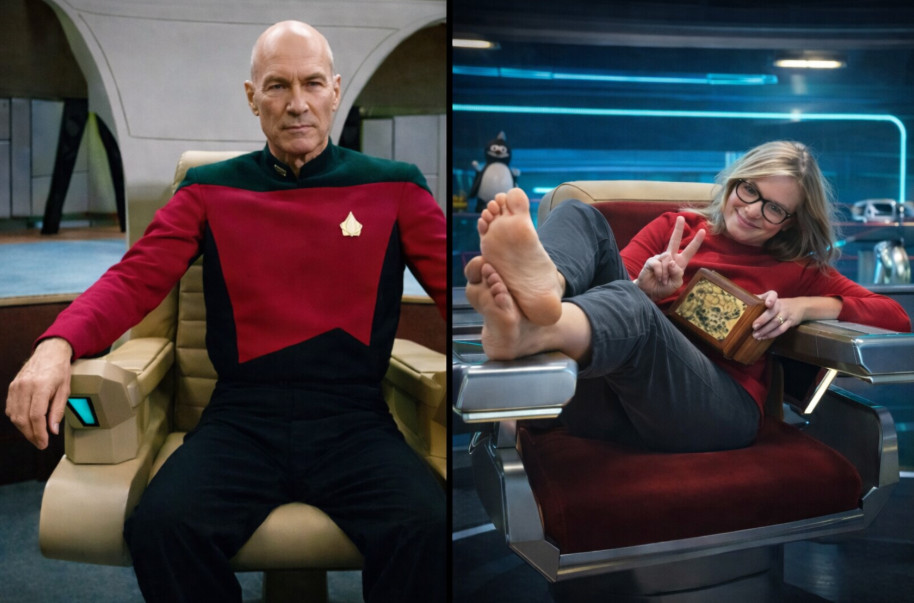
A lot of that probably comes from how I connected with Star Trek growing up. I didn't have a strong father figure in my life, and characters like Kirk and especially Picard filled that gap more than I realized at the time. Picard wasn't just a captain. He was thoughtful, patient, ethical, and steady. I was around thirteen or fourteen when The Next Generation aired, and Picard became a kind of surrogate father figure for me. Star Trek used to be about competent adults wrestling with serious ideas, and that mattered.
So my problem with Starfleet Academy isn't that the characters are young. It's that they often feel too young. Academy students should feel like young adults, focused on their future and their responsibilities, not teenagers trapped in emotional loops. That's one of the reasons I eventually bailed on the CW superhero shows. I love Supergirl. I love Green Arrow. I love The Flash. But those shows became ten minutes of story and cool effects followed by thirty or forty minutes of teen drama and woe-is-me conversations. I ended up putting them on in the background while reading something else, then looking up when something actually happened. That's unfortunately how I'm watching Starfleet Academy right now. When I realize I've missed five minutes of plot and it turns out nothing important happened, that's not a great sign.
The Burn is still part of the background, and I've mostly accepted that. It happened. It's history. Fine. My issue is that modern Trek won't stop poking at it. We've already seen the fallout. We've seen worlds become isolationist. We've seen entire cultures hide themselves because of it. At this point, I want the Burn left alone. Let it be part of history. Stop dragging it back into the story as a justification for everything that feels broken.
If this is an academy, I want to see training that actually feels meaningful. I get the pranks and rivalries, but where are the real tests? Where are the Kobayashi Maru-style scenarios that force hard choices and leave scars? Training should have consequences. Starfleet officers aren't trained at summer camp. They're shaped by pressure, failure, and responsibility. Otherwise, it starts to feel more like an extended orientation week with phasers.
Authority is another problem. Star Trek has always treated the uniform as something sacred. It represents discipline and shared purpose. That's why the barefoot chancellor bugs me so much. Not because she's a woman, but because it makes the institution feel unserious. Walking around barefoot, feet on the desk, slouched in meetings, curled up in her captain's chair, it feels less like Starfleet and more like a relaxed retreat center that just happens to issue rank insignia. I actually like the actress quite a bit. She was great in Batman v Superman. This isn't about performance. It's about tone.
The dialogue also trips me up. A lot of it sounds like present-day social media, and that pulls me right out of the far future. I get that writers want characters to sound relatable, but Star Trek has always had its own voice. People spoke like they believed in ideas bigger than themselves. When everyone sounds like they just stepped out of a 2026 comment thread, the illusion cracks. I'm not saying everyone has to be a Shakespearean actor like Patrick Stewart, or talk.... with...... random.. pauses..... like..... James T........ Kirk... but come on. There's a middle ground.
Caleb, the main character, hasn't really grabbed me yet. His backstory is interesting. Escaped as a child. On the run. Prison time. Rescued by Starfleet leadership. And then almost immediately, it feels like that history gets ignored. Suddenly he's just another academy student, and the weight of that past barely registers. Even in the pilot, when he pulls off some last-minute computer hacking miracle to save the day, it feels a little too convenient and over the top, even by Star Trek standards.
Klingons are a mixed bag. They're definitely an improvement over Discovery, and I'm grateful I don't have to read subtitles nonstop anymore. I like hearing Klingon in small doses, but when you're constantly reading subtitles, you miss the actor's performance. Star Trek VI nailed this. A line or two in Klingon, then switch to English and let Christopher Plummer do his thing. Also, something about the Klingon's voice here sounds off to me. Too low, too processed, almost fishy. I can't quite put my finger on it. And enough with everyone being half-this, half-that. It worked with Spock. It worked with B'Elanna Torres. Now it feels overused.
The far-future setting is still a problem for me. The further Trek pushes into the future, the more ridiculous the technology becomes. When everything is absurdly powerful, tension disappears. Constraints make stories interesting, and the 32nd century has too few of them. One of my favorite things about Enterprise was that they were still discovering how the new technology at the time worked. Transporters were just barely approved for human use. They didn't have tractor beams or photon torpedoes, and so it was cool seeing those things being introduced. Now it's like we've got a transporter built into a pistol that we can use during games. Lame. That's not tension. That's a cheat code.
Then there's the USS Athena. I'm sorry, but it's ugly. Starfleet ships used to look like they were designed by engineers solving problems. The Athena looks like it was designed to look different, not by engineers, but by a focus group armed with crayons and a mandate to stand out. The detachable nacelle trend from Discovery still bugs me too. Warp engines aren't accessories. They're supposed to be bolted on, structural, purposeful. Form used to follow function in Star Trek, and that philosophy seems to be getting lost.
All that said, I don't think the acting is the problem. I think the cast is doing fine. The issues here are structural and tonal. And I keep reminding myself that Star Trek has always stumbled early. The first season of The Next Generation had some real clunkers. Deep Space Nine didn't truly find its footing until the Dominion War. I'm giving Starfleet Academy a chance. I'll suffer through the first season if history is any guide.
One of the things I actually enjoy a lot is the drill instructor, Commander Lura Thok, who's this half-Klingon, half-Jem'Hadar cadet master on the Athena. At first I thought, why are they doing the half-and-half thing again, but her performance totally sells it. She's tough, no-nonsense, and gives off real disciplinary energy, not just teen angst. I hope the writers don't soften her too much or turn her into a buddy to the students. She feels like someone who's actually earned her authority, and that's a refreshing breath of old Trek discipline.
One other thing I genuinely hope they follow up on is Paul Giamatti's character from the pilot. I've always liked him as an actor, and I thought he did a great job right out of the gate here. He brought some real presence and weight to the role, and that's something the show could absolutely use more of. If they're smart, they'll bring him back as a recurring antagonist instead of a one-and-done villain. Star Trek has always been at its best when its villains feel intelligent, motivated, and persistent, not just obstacles of the week. Q was the perfect example of this. Until they "killed" him. Big mistake, in my opinion. Star Trek has always been better when its villains come back smarter and more annoying each time.
The look and feel of the show impress me too. The sets really do feel big and solid, and I've read that this might be the biggest set Star Trek has ever used, which shows in the visuals. The new bridge design is neat and even has a bit of that Strange New Worlds echo to it without just copying someone else's style. The lighting, the costumes, the polish overall all feel high quality.
I also like that The Doctor is back and still feels like himself. He was a fun part of Voyager, and seeing him in this far future gives a sense of continuity that helps pull this new generation into the bigger franchise. Although I do admit that I really liked the grumpy Doctor with the horrible bedside manner of the first couple Voyager seasons more than the kinder, funnier Doctor he became over time.
Starfleet Academy has potential. I'm not giving up on it. I'm just hoping it remembers what made Star Trek aspirational in the first place. Competence. Curiosity. Consequences. And adults who lead like adults.
LLAP
RR
P.S. Oh, and if anyone at Paramount ever stumbles across this, I've had a Star Trek idea rattling around my head for decades. An anthology series. Twilight Zone-style Trek. Every episode stands alone. Different era. Different crew. Different corner of the universe. One week in Picard's era. Another in Archer's time. A Klingon story. A Ferengi story. Bring back legacy actors when it makes sense. Modern virtual set tech makes this more doable than ever, without being trapped in one timeline or one cast. I'm available to consult. Call me.

No comments:
Post a Comment